
The dollar-to-naira gap day by day
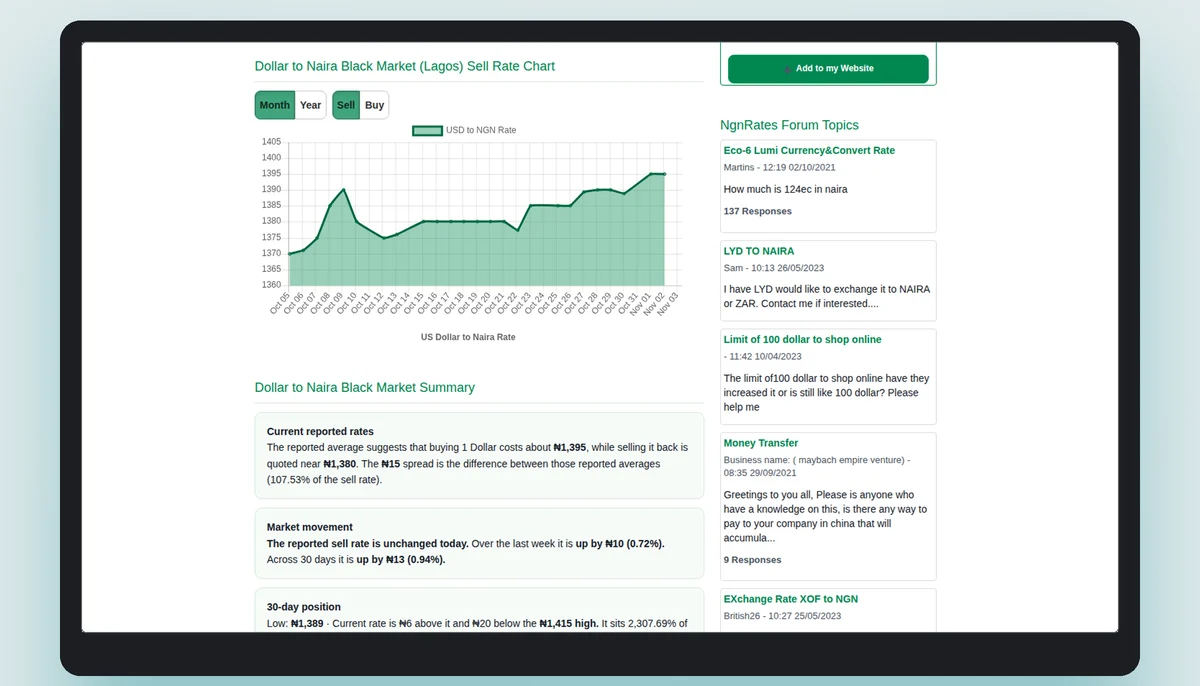
The official rate and the street rate move for different reasons, and the gap between them is the most important number to watch. This page shows the last two weeks of days, with the official rate, the street sell rate and the gap in naira and per cent. The official rate has no row for weekends and holidays because the CBN does not print one. Street quotes continue through the weekend, so some days carry only one side. The record combines the CBN's own history with the street series.
The official and street dollar, day by day
Each day's official rate, street sell rate and the gap, with the street rate's change from the previous row.
| Day | Official | Street, selling | Gap | Gap, % |
|---|---|---|---|---|
| 02 Nov | ₦1,347.94 | ₦1,395.00 | ₦+47.06 | 3.49% |
| 30 Oct | ₦1,346.26 | ₦1,389.00 | ₦+42.74 | 3.17% |
| 29 Oct | ₦1,346.91 | ₦1,390.00 | ₦+43.09 | 3.20% |
| 28 Oct | ₦1,347.53 | ₦1,390.00 | ₦+42.47 | 3.15% |
| 27 Oct | ₦1,352.87 | ₦1,389.33 | ₦+36.46 | 2.70% |
| 26 Oct | ₦1,367.61 | ₦1,385.00 | ₦+17.39 | 1.27% |
| 23 Oct | ₦1,361.84 | ₦1,385.00 | ₦+23.16 | 1.70% |
| 22 Oct | ₦1,344.40 | ₦1,377.50 | ₦+33.10 | 2.46% |
| 21 Oct | ₦1,334.72 | ₦1,380.00 | ₦+45.28 | 3.39% |
| 20 Oct | ₦1,333.65 | ₦1,380.00 | ₦+46.35 | 3.48% |
| 19 Oct | ₦1,333.72 | ₦1,380.00 | ₦+46.28 | 3.47% |
| 16 Oct | ₦1,332.26 | ₦1,380.00 | ₦+47.74 | 3.58% |
| 15 Oct | ₦1,331.61 | ₦1,380.00 | ₦+48.39 | 3.63% |
| 13 Oct | ₦1,332.97 | ₦1,376.00 | ₦+43.03 | 3.23% |
| 12 Oct | ₦1,332.10 | ₦1,375.00 | ₦+42.90 | 3.22% |
Rates of: 02.11.2026
What the columns show
The table above this text lists each day in the last two weeks for which both a CBN official rate and a street sell rate exist. The official rate is the CBN's volume-weighted NFEM rate for that trading day. The street rate is the Lagos sell average from NgnRates.com for the same day. The gap is the street rate minus the official rate, shown in naira and as a per cent of the official rate.
Weekends and public holidays are missing from the official column because the CBN publishes no rate on those days. The street column may have a quote on a weekend, but since the official side is blank, that day is not included in the gap calculation. The table only shows days when both rates are available, so the gap is always a valid comparison.
Why the official rate moves
The official rate moves when the CBN's monetary policy changes, when the supply of dollars in the official window shifts, or when large transactions are reported. The rate is a volume-weighted average, so a few large deals can move it more than many small ones. The CBN may also adjust the rate directly, though in recent years it has allowed the rate to be market-determined within a band.
The official rate does not move on weekends or holidays because the market is closed. On a Monday, the rate reflects the first trades of the new week. A reader looking at the day-by-day table should note that the official rate changes less frequently than the street rate, because it is an average of bank deals rather than a single dealer's quote.
Why the street rate moves
The street rate moves with the demand for cash dollars in Lagos and other cities. When demand is high, dealers raise their sell rates; when demand falls, they lower them. The street rate also responds to news about the official market: if the CBN devalues the naira or restricts dollar supply, street dealers adjust their quotes within hours.
Because the street rate is an average of posted quotes, it can be volatile. A single dealer posting a high sell rate can push the average up, even if other dealers are quoting lower. The rate is also influenced by the amount of dollars in circulation and the cost of sourcing cash dollars from banks or other dealers.
Why the gap matters more than either rate alone
The gap between the street sell rate and the official rate is the premium a cash buyer pays over the official price. A widening gap means the official dollar is becoming harder to get and the street premium is growing. A narrowing gap means the two markets are converging, and the official market is meeting more demand. The gap is a measure of the pressure in the foreign exchange market.
A reader who only looks at the official rate might think the naira is stable, while the street rate shows a different story. The gap captures that difference. A reader who only looks at the street rate might miss the fact that the official market is improving. The day-by-day table shows both and lets the reader see the trend.
What a narrowing or widening gap tells you
A widening gap over several days suggests that the official market is not supplying enough dollars, and buyers are turning to the street. It may also reflect expectations of a devaluation, which makes dealers hold back stock and raise prices. A narrowing gap suggests that the CBN is supplying more dollars or that demand is falling, and the street premium is shrinking.
The gap can also widen or narrow for technical reasons. For example, a single high street quote on a day with few posts can widen the gap temporarily. The official rate may be provisional and later revised, which would change the gap. A reader should look at the trend over several days rather than a single day's move.
How to use the day-by-day record
Start by noting the most recent gap and whether it is wider or narrower than the gap a week ago. Then look at the official rate: has it moved, or is the change coming from the street side? If the official rate is stable and the street rate is rising, the pressure is in the cash market. If both are rising, the naira is weakening across the board.
Remember that the street rate is an average of posted quotes, often one per side, so day-to-day moves may be noise. The official rate is more solid but can be provisional. Use the table to see the direction of travel, not to predict tomorrow's rate. No forecast is made on this site.
Key facts about the day-by-day record
Read next
Questions about the dollar rate
Why are there no official rates on weekends?
The CBN publishes the NFEM rate only on trading days, which are weekdays except public holidays. The official market is closed on weekends, so no trades occur and no rate is printed. The street market continues through the weekend, so street quotes may appear, but the gap cannot be calculated without an official rate.
Why does the table show only days with both rates?
The gap is the street rate minus the official rate, so both are needed. On a weekend, the official rate is missing, so that day cannot be included in the gap series. The table shows only days when both a CBN figure and a street figure exist, to keep the comparison valid.
What does a widening gap mean?
A widening gap means the street sell rate is rising faster than the official rate, or the official rate is falling while the street rate stays high. It indicates that the official dollar is becoming harder to get and the street premium is growing. It is a sign of pressure in the foreign exchange market.
Can the gap be negative?
In theory the street sell rate could fall below the official rate, but in practice the street rate is almost always higher because cash dollars carry a premium. A negative gap would mean the street dealer is selling below the official price, which is unlikely unless the official rate is very high or the street market has a surplus of dollars.
How reliable is the street rate in this table?
The street rate is an average of dealer quotes posted by users on NgnRates.com. On many days it is a single quote per side, so it is a thin reflection of the cash market. It is not a survey of bureaux and should be treated as a rough indication, not an exact price.
A contract on the dollar-naira rate, settled without cash exchange
FxPro offers a contract for difference on the dollar-naira pair. You do not buy or sell physical dollars; the contract is settled in your account currency. Opening an account requires identification and takes a day or two, and a practice account costs nothing.